There have been lots of plans in the works, friends, and many exciting things to come! Two weeks ago, Elizabeth Stewart Clark of the Sewing Academy came out for a workshop series with the Living History Society. I will write more about that in a separate post, but as a teaser: her butt has been in the front seat of my car. (Insert fangirl screaming here)
Prior to that, however, Melissa of The Deviant Dressmaker (aka my protege) and I launched an exciting new blog project: The Historical Food Fortnightly!
I approached Melissa with this idea some months ago, and still don't remember how it popped into my head - a year's worth of challenges, every two weeks, asking participants to research, document and reproduce historical food dishes and recipes. She thought it was a cool idea too, so we've been plotting and scheming over the winter and have now launched the project!
The idea is shamelessly inspired by other fortnightly challenges from around the interwebz (in particular Leimomi of The Dreamstress, who has given us her blessing). Every two weeks (or fortnight - get it?), a new themed challenge begins. Each participant creates a dish inspired by that theme. They then post their results on their blog, along with their documentation and research. We'll share our own results, and highlight some participants as well.
We announced the project two weeks ago, and the response has been overwhelming. We're already close to 200 participants on the Facebook group, plus blog followers. We have people participating from all over the world, and from all different eras. There are professional living historians who cook historic foods every day at their sites, hobbyists with a variety of experiences and skill sets, historians who like food, and foodies who like history. There are people cooking foods from the 1950s all the way down to 10th century Vikings and Ancient Greece (like, I can't even wrap my mind around that, they must be made of magic).
I hope you will consider joining us, gentle reader - the only rule is "research and document", the rest is up to you!
Wednesday, May 7, 2014
Thursday, April 3, 2014
Sharpening Your Pencil
Anyone tired of hearing about my day-job yet? This has been a really critical time for my team and I, and we've been working extra hard while making plans for the year. We have a new boss who is awesome and really wants to take our team to the next level. In a planning meeting this week, she used this analogy: "Everyone is like a pencil. We are all great and work hard, but occasionally we get worn down and we need sharpening to make us even better."
This, of course, is a pretty good analogy for anything in life. It naturally got me thinking about reenacting (because let's face it, everything goes back to reenacting). In what ways do we (and can we) sharpen our pencils as reenactors?
One of the biggest mistakes reenactors can make (in my opinion) is to become complacent about what they know, or what they think they know. Knowledge is a living, changing thing with a quantifiable life - just check out this video of author Sam Arbesman, summing up his book The Half-Life of Facts, which discusses this exact topic. He focuses more on science and medicine, but the same holds true for social sciences like history.
In the past decade, since I started reenacting, digitized collections have exploded all over the Internet, allowing historians access to collections all across the world. It has put information right at our fingertips and made it even easier to compare different sources and find new avenues of research. We no longer have to go across the country or around the world to find the resources we need.
It also means that every day there are new things being digitized. Google Books, the Library of Congress, Project Gutenberg, the Digital Library and Archives.org are all digitizing new sources every day from some of the greatest research libraries in the world. Museums like the Met, the Kyoto Institute and LACMA are photographing their collections of historic clothing. This means that the things we thought we knew ten years ago (or even yesterday!) are now potentially outdated as we discover new sources we may never have stumbled across otherwise.
There are lots of fads we have seen discounted, myths dispersed, and the nuances of life and material culture in the mid-19th century better defined. When I started reenacting nigh onto thirteen years ago, it was widely assumed that straw bonnets were only for summertime wear, gigantic hoops were "in", and those rugby-striped stockings were all the rage.
Today? We now know that straw bonnets show up well into the fall in fashion illustrations. Ladies have a better understanding of the realistic ideal size of a hoop based on one's height and shoulder width. And the pendulum has swung back and forth on the striped stockings, with new research being added all the time.
Those are only three examples. Imagine if one hadn't done any reading or research in those ten years, figuring that they had all the answers they needed for a good impression. Think about how outdated their research would be! Their pencil would, indeed, be quite dull.
We owe it to the public to whom we present to keep our pencils sharp. We owe it to the historical community as well- we are representatives and all play a vital role. Most of all, we owe it to ourselves to challenge ourselves to a better, broader, sharper understanding of life in the era that we interpret.
How do you sharpen your pencil? What plans do you have for sharpening your pencil? Leave a comment!
This, of course, is a pretty good analogy for anything in life. It naturally got me thinking about reenacting (because let's face it, everything goes back to reenacting). In what ways do we (and can we) sharpen our pencils as reenactors?
One of the biggest mistakes reenactors can make (in my opinion) is to become complacent about what they know, or what they think they know. Knowledge is a living, changing thing with a quantifiable life - just check out this video of author Sam Arbesman, summing up his book The Half-Life of Facts, which discusses this exact topic. He focuses more on science and medicine, but the same holds true for social sciences like history.
In the past decade, since I started reenacting, digitized collections have exploded all over the Internet, allowing historians access to collections all across the world. It has put information right at our fingertips and made it even easier to compare different sources and find new avenues of research. We no longer have to go across the country or around the world to find the resources we need.
It also means that every day there are new things being digitized. Google Books, the Library of Congress, Project Gutenberg, the Digital Library and Archives.org are all digitizing new sources every day from some of the greatest research libraries in the world. Museums like the Met, the Kyoto Institute and LACMA are photographing their collections of historic clothing. This means that the things we thought we knew ten years ago (or even yesterday!) are now potentially outdated as we discover new sources we may never have stumbled across otherwise.
There are lots of fads we have seen discounted, myths dispersed, and the nuances of life and material culture in the mid-19th century better defined. When I started reenacting nigh onto thirteen years ago, it was widely assumed that straw bonnets were only for summertime wear, gigantic hoops were "in", and those rugby-striped stockings were all the rage.
Today? We now know that straw bonnets show up well into the fall in fashion illustrations. Ladies have a better understanding of the realistic ideal size of a hoop based on one's height and shoulder width. And the pendulum has swung back and forth on the striped stockings, with new research being added all the time.
Those are only three examples. Imagine if one hadn't done any reading or research in those ten years, figuring that they had all the answers they needed for a good impression. Think about how outdated their research would be! Their pencil would, indeed, be quite dull.
We owe it to the public to whom we present to keep our pencils sharp. We owe it to the historical community as well- we are representatives and all play a vital role. Most of all, we owe it to ourselves to challenge ourselves to a better, broader, sharper understanding of life in the era that we interpret.
How do you sharpen your pencil? What plans do you have for sharpening your pencil? Leave a comment!
Thursday, March 27, 2014
Winter Weekend 2014
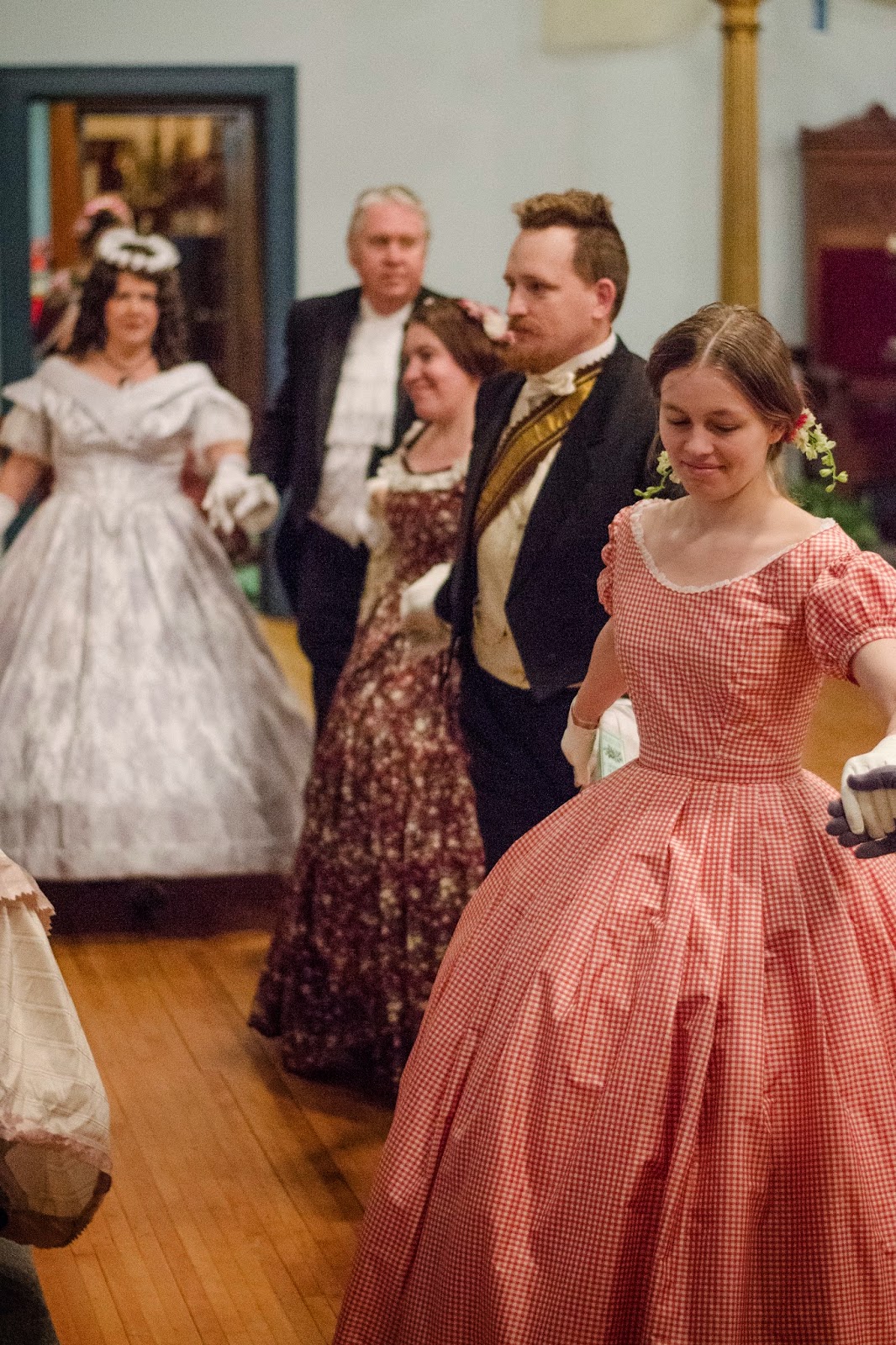
I just realized the other day that I never posted anything about our winter ball! My group puts on an annual Celebration of Winter each year, known also as "Winter Weekend". It is a weekend full of funtivities and socializing, the centerpiece of which is a formal ball on Saturday night.
I'm a little biased but I think we throw the best ball in the region. One of the best parts of our ball is the location, at a well-restored historic Masonic temple. We get to use candles there. Dancing by candlelight - does it get any better? I also have wonderful, beautiful friends who make wonderful, beautiful dresses and show up to be wonderful and beautiful (oh, and the guys clean up nice too). The emphasis is on recreating a very accurate experience, with proper etiquette observed; all the gents dance with all the ladies, and no one sits out. We also have a massive, sit-down formal dinner during the evening, with recreated Victorian food and actual service a la francais, which is such a rare treat.
This year, we hired a professional photographer (my friend Anne, whose work has been shown on this blog before, and who is still as amazing as always, if not more so) to document the ball and get some really good shots of all the action. You can see more at her blog, but here are a few of my favorites. Enjoy, and see if you can spot Yours Truly!
I'm a little biased but I think we throw the best ball in the region. One of the best parts of our ball is the location, at a well-restored historic Masonic temple. We get to use candles there. Dancing by candlelight - does it get any better? I also have wonderful, beautiful friends who make wonderful, beautiful dresses and show up to be wonderful and beautiful (oh, and the guys clean up nice too). The emphasis is on recreating a very accurate experience, with proper etiquette observed; all the gents dance with all the ladies, and no one sits out. We also have a massive, sit-down formal dinner during the evening, with recreated Victorian food and actual service a la francais, which is such a rare treat.
This year, we hired a professional photographer (my friend Anne, whose work has been shown on this blog before, and who is still as amazing as always, if not more so) to document the ball and get some really good shots of all the action. You can see more at her blog, but here are a few of my favorites. Enjoy, and see if you can spot Yours Truly!
Monday, March 17, 2014
How To Drink Tea
Just a brief post to wish you all a Happy St. Patrick's Day! If you're in the northern hemisphere, I hope spring is coming your way! It's very gloomy and cloudy here today, but we have temperatures above freezing! This weekend I ate soda bread and watched my favorite movies and TV shows that remind me of my time in Ireland - The Quiet Man, Waking Ned Devine, and Father Ted.
I have other blog posts I'm working on, in between being sick (seriously, three times in the last six weeks, I'm sick of being sick!). For today, though, I want to share an article written by dear friend, former roommate, kindred spirit, freelance writer, fellow crafter and all-around good egg Ada from Of Woods and Words. She wrote a really splendid article about the proper way to brew a pot of tea. I never enjoyed tea until I started taking tea with reenacting friends who knew how to brew A Very Proper Pot and discovered a whole new world of aromas and layered flavors and rituals.
So, pull out your tea pots, dump those leaves right in, and enjoy!
I have other blog posts I'm working on, in between being sick (seriously, three times in the last six weeks, I'm sick of being sick!). For today, though, I want to share an article written by dear friend, former roommate, kindred spirit, freelance writer, fellow crafter and all-around good egg Ada from Of Woods and Words. She wrote a really splendid article about the proper way to brew a pot of tea. I never enjoyed tea until I started taking tea with reenacting friends who knew how to brew A Very Proper Pot and discovered a whole new world of aromas and layered flavors and rituals.
So, pull out your tea pots, dump those leaves right in, and enjoy!
![]() |
| A Lady Taking Tea, Jean-Simone Che Chardin, 1735 |
Thursday, February 27, 2014
So I've been a little missing...
...and there's good reasons for that.
First, my laptop decided it wanted to go to sleep for a really long time. Like, a forever long time. A shorted motherboard left me computerless for a couple weeks. I stayed in touch with the world via my smart phone and tablet, but there's no replacement for a decent computer. I now have a new lovely laptop (christened Jenny Lind).
I was also ill a couple times. I don't know if you know this, but I am a big baby when I'm sick. I had the cold from hell for a couple weeks (a resurgence of the bug that had me down just before Christmas) and a recent bout with a stomach bug (ew). Being a baby means that I pretty much put off everything when those suckers hit, and I've been playing catch-up ever since.
The good news is that I am back on my A-game (mostly) and I have lots of things that I've been working on for posting here. Stick around!
First, my laptop decided it wanted to go to sleep for a really long time. Like, a forever long time. A shorted motherboard left me computerless for a couple weeks. I stayed in touch with the world via my smart phone and tablet, but there's no replacement for a decent computer. I now have a new lovely laptop (christened Jenny Lind).
I was also ill a couple times. I don't know if you know this, but I am a big baby when I'm sick. I had the cold from hell for a couple weeks (a resurgence of the bug that had me down just before Christmas) and a recent bout with a stomach bug (ew). Being a baby means that I pretty much put off everything when those suckers hit, and I've been playing catch-up ever since.
The good news is that I am back on my A-game (mostly) and I have lots of things that I've been working on for posting here. Stick around!
Tuesday, January 14, 2014
Tips Tuesday!
I don't know if this is going to start a trend here, but it's Tuesday so I thought I'd share a helpful tip with you! I have a bit of an obsession with life hacking and get a really sinister kind of glee when I find a new way to hack my life and make myself more productive.
I was recently involved in a discussion on Facebook about burn tests. A burn test is a test one does to find out the fiber content in a piece of fabric; you burn a scrap of fabric and check the results to determine what kind of fibers are included in the fabric. It involves smelling the burning fabric, observing the ash characteristics, and observing the way it extinguishes. Most fabric shops have labels on their fabrics denoting the fiber content, but industry standards allow fabric manufacturers to be a bit misleading. The big fabric mecca warehouse outlets often do not have fiber content listed on bolts - or if they do, it's something generic like "wool blend" or just plain old "twill".
I'm lucky - my local fabric mecca will burn fabrics for me. Most people have to get swatches and burn their own fabrics, sometimes out in the parking lot (which does look a little suspect to the non-fiberfiles). Making sure you always have your burn test materials on hand when you go shopping is important, but if you're like me, that's a dicey proposition.
The best way to make sure you have all your burn test supplies on hand? Make a traveling burn test kit. Before I explain, let's remember that anything involving fire should be done in a controlled environment, with water on hand, and taking every precaution necessary to prevent burns. Fabric burns fast; fabric of an unknown fiber source can behave in unexpected ways (like melting or burning very quickly). I take no responsibility for those who perform burn tests without using common sense; try this at home, but you do it at your own risk. Alright? Alright.
First, get this flow chart from The Lovely Doll Company and print it out.
I think it has the best information and makes it quick and easy to decipher just what you're looking for. You can laminate it and roll it up so that it stays fresh forever, or fold it up as-is if you don't mind occasionally reprinting.
Next, get a small tin like an Altoids container. Bonus points if you recycle, but if you need to buy new, Specialty Bottle sells small tins as well. A metal container won't get wet, but you could use anything you find helpful - a plastic container, a small bottle, and so on.
Finally, add a child-proof lighter or matches, whichever is your weapon of choice for causing a conflagration, and a tool for holding onto the fabric, as it's a really bad idea to light any fabric while you're holding it in your fingers. The best choice is a pair of forceps from a medical supply company or, if you're lucky, your local pharmacy. You can also use tweezers, but be careful with smaller tools.
Voila! Put it in your car or in your purse and you have a burn test kit for the fiberfile on-the-go. All your supplies will be together for your next trip to the fabric store.
What other tips do you have for fabric shopping? Share in the comments!
I was recently involved in a discussion on Facebook about burn tests. A burn test is a test one does to find out the fiber content in a piece of fabric; you burn a scrap of fabric and check the results to determine what kind of fibers are included in the fabric. It involves smelling the burning fabric, observing the ash characteristics, and observing the way it extinguishes. Most fabric shops have labels on their fabrics denoting the fiber content, but industry standards allow fabric manufacturers to be a bit misleading. The big fabric mecca warehouse outlets often do not have fiber content listed on bolts - or if they do, it's something generic like "wool blend" or just plain old "twill".
I'm lucky - my local fabric mecca will burn fabrics for me. Most people have to get swatches and burn their own fabrics, sometimes out in the parking lot (which does look a little suspect to the non-fiberfiles). Making sure you always have your burn test materials on hand when you go shopping is important, but if you're like me, that's a dicey proposition.
The best way to make sure you have all your burn test supplies on hand? Make a traveling burn test kit. Before I explain, let's remember that anything involving fire should be done in a controlled environment, with water on hand, and taking every precaution necessary to prevent burns. Fabric burns fast; fabric of an unknown fiber source can behave in unexpected ways (like melting or burning very quickly). I take no responsibility for those who perform burn tests without using common sense; try this at home, but you do it at your own risk. Alright? Alright.
First, get this flow chart from The Lovely Doll Company and print it out.
I think it has the best information and makes it quick and easy to decipher just what you're looking for. You can laminate it and roll it up so that it stays fresh forever, or fold it up as-is if you don't mind occasionally reprinting.
Next, get a small tin like an Altoids container. Bonus points if you recycle, but if you need to buy new, Specialty Bottle sells small tins as well. A metal container won't get wet, but you could use anything you find helpful - a plastic container, a small bottle, and so on.
Finally, add a child-proof lighter or matches, whichever is your weapon of choice for causing a conflagration, and a tool for holding onto the fabric, as it's a really bad idea to light any fabric while you're holding it in your fingers. The best choice is a pair of forceps from a medical supply company or, if you're lucky, your local pharmacy. You can also use tweezers, but be careful with smaller tools.
Voila! Put it in your car or in your purse and you have a burn test kit for the fiberfile on-the-go. All your supplies will be together for your next trip to the fabric store.
What other tips do you have for fabric shopping? Share in the comments!
Thursday, January 9, 2014
A Eulogy for My Favorite Fabric Shop
With the end of October last year came the very, very sad announcement that Mill End Textiles, a local chain of fabric outlets in the upper Great Lakes region, is closing for good. The rumor mill has it that the stores will be completely closed by February. To that end, please indulge me in a little bit of public grieving.
Oh, Mill End. What shall I do without you in my life? You were the first fabric shopping experience I ever had when I was 14 years old and needed cotton shirting for my first sewing project in Clothing Tech class at Johnson High School. I got the fabric for my first monstrosity of a pagoda-sleeved calico dress from your hallowed aisles. Since then, at least half of my historical dresses have come from Mill End.
You were always there. When I needed a couple yards of fabric to make up a little girl’s pinafore for a museum in Oregon, your stacks of flat-fold calicos were like the Promised Land. Whenever I needed a silk remnant for a lining, you were there. You were better than any therapist has been or could be for me. Your employees were ever-patient while I dithered over the contrasting fabric for my wrapper. They celebrated with me when I found the acorn fabric, they ooh-ed and ahh-ed with me over the Empress gown fabric, they agreed that that red and green paisley was just so ugly it was beautiful. They turned a blind eye on the quiet evenings when I laid out a variety of silks to take pictures to send to friends for opinions and further pondering. And whenever Joanns or Hancock let me down, you welcomed me back with open arms and said, “It’s alright. Have a coupon. And all calicos are 50% off this month.”
Do I even need to mention the convenience (and inconvenience) of your location just a stone’s throw from work? And yes, though SR Harris will step up to fill the large Mill End-sized hole in my heart, there will still be no beating the convenience and proximity.
At least I have your massive, massive fabric sale to console me. But I shall always regret you.
Subscribe to:
Posts (Atom)