Sunday, March 15, 2020

Your First Reenacting Investments

A recent conversation on social media regarding how to help teenage reenactors get started on the right foot. This is a topic near and dear to my heart, because I started reenacting at age 15! I found a group of people locally who also enjoyed history and exploring the past. I joined up on my own, with no family involvement, and with the help of my friends got started in reenacting.

Getting started as a teenager, especially a solo teenager, is not easy. Reenacting can be an expensive hobby, and there are so many pieces of your impression to acquire. It can be daunting! So I thought I would share one of the lessons I learned: what purchases or investments to prioritize when you are building an impression from scratch, with very little income.

Here we go!

1. A Good Pair of Shoes or Boots

My feet on the right!
This is one of the first things I invested in as a reenactor. It may be the last thing a newbie thinks of, but it definitely shouldn't be. Good footwear is always worth an investment, to keep your feet and legs and back happy and healthy. But as a reenactor, a good pair of shoes or boots is truly an investment. Kept well, they will last forever. I'm not kidding, I still have the leather bootees I bought 15 years ago. Good workmanship lasts.

Compare that to a pair of okayish faux leather shoes from your favorite department store that will maybe last a couple seasons. You'll have to replace them in short order, and spend more money, which means you won't be saving much over buying one pair of high-quality leather shoes or boots. Even if they last a while, you'll want to replace them as you continue progressing in your living history impression. Spend a little now, save a little later.

For a high quality choice that's budget conscious, I recommend Fugawee - the folks who made those 15 year old boots. Their Victorias are a great choice. I also love my walking shoes from Amazon Dry Goods. If you want to splurge, there's no one better than Missouri Boot and Shoe for quality and accuracy.

2. Skirt Supports Of Your Choice

Again, this is one of the biggest investments you can make. There are many, many options to chose from, from the patterns put out by Truly Victorian and Past Patterns, to a kit or fully-made cage crinoline from Needle and Thread in Gettysburg. You can choose a pattern for a covered cage, or an uncovered cage style - both are good options.

The reason why you should invest in this right way is because you will always need it. The mid-19th century silhouette depends on the wide, domed skirt. Without it, you just don't look like the real deal. You can definitely choose the accurate option of wearing several petticoats under your dress, but that's going to limit your impressions as supported skirts were accessible to all socioeconomic classes in the 1860s.

For Christmas the year I started reenacting, when I was sixteen years old, my parents bought me a cotton-covered hoop skirt. It adjusted it to give it the right size and shape and wore it for twelve years. Twelve years! I finally threw it away in 2015, when moving apartments, because the bones had rusted and broken. Twelve years is a pretty good investment, and if you take good care of it, your hoop or cage can last just as long, maybe longer.

3. A Corset Made To Fit You

Last, but absolutely not least! A good corset will last for years and years. And like those skirt supports, you cannot look like The Original Cast without it - end of story. Moreover, you should get a corset that is made for you. A well-fitted corset is very comfortable and will last longer than a poorly-fitted corset. And by well-fitted, I mean it was cut, fitted and made on your body. (Long line bras do not count. Neither do sports bras. Just. No.)

You also need a corset to fit all the wonderful clothes you'll be making and acquiring. So before you start sewing those dresses, get a good corset.

You can hire someone to make you a corset, and it will cost you quite a bit. But if you're willing, sewing your own corset is pretty easy and inexpensive. It took me fifteen years and a lot of frustration to work up the courage to try sewing a corset and learn this lesson.

There are great patterns out there - Past Patterns, Truly Victorian, and Laughing Moon all have really great options. I made mine with the Laughing Moon patterns and you can't beat having the DVD for guidance. I have heard really really good things about the new Redthreaded corset options, both in buying a custom corset and using the patterns.

Elizabeth Stewart Clark has even put together a list of what supplies you need and where to get them! She's taken a ton of guess work out of the process for you. Get bold - give it a whack!

One Final Bonus Tip...

As a teenage reenactor, you may not have the kind of disposable income that your more age-accomplished sister reenactors have. If you have a small income, you can start saving up your money for some of these bigger purchases. However, saving $150 for a pair of shoes can be daunting when you're working a very part-time job. I know, because it was for me.

One of my greatest tips for teenage reenactors: supportive relatives and friends will love to help you acquire things! If you are receiving birthday or holiday gifts, ask for some of the things you need! My parents made it clear they weren't going to be part of my reenacting adventures, but they were (and still are) proud of me for chasing my crazy, nerdy dreams and wanted to support me. Each year I sent them an updated list of a couple things I wanted and needed, including where they could find them. They bought me bonnet kits from Timely Tresses, lengths of fabric, even gift certificates for my favorite antique stores. My mom once snuck into a sutler booth at a reenactment when she came to pick me up to secretly buy a brooch I loved, and gave it to me for my birthday. I still have that brooch and wear it, and it always reminds me of my parents and the ways they supported me.

I hope you have decades of fun and learning, just like I have, and that these tips make your entry into reenacting just a bit easier.

Sunday, August 5, 2018

A Brief Discussion of Fancy Dress


My home group, the Living History Society of Minnesota, is planning a fancy dress party for the weekend before Halloween! I love a good fancy dress party! I was asked by a few people to share some information about fancy dress in the mid 19th century and so I hope this post can serve as an introduction to those who may be encountering the idea of fancy dress for the first time.

Fancy dress parties were a very popular form of entertainment in the 19th century. Just as people today enjoy dressing up in costumes for fun, so did the Original Cast of the 19th century. Fancy-dress  was an opportunity for people to show off their creativity, loosen up social restraints, and put on a different persona. They were popular all the way from the courts of France and England to parties among soldiers and sailors.

Unlike earlier bal masques from the 18th century, fancy dress parties were less about complete disguise or anonymity. In images and descriptions masks are rarely shown or described. Instead, the emphasis seems to have been on how creative the wearer could be, rather than on how mysteriously they could disguise themselves.

Godey's Ladies Book October 1


This image shows a fashion plate of fancy dress costumes from Godey’s 1866. As shown in many illustrations, it was perfectly acceptable for ladies to wear shorter skirts for fancy dress parties – even as short as calf length! Some costumes call for the lady’s hair to be left down. Obviously, fancy dress was an opportunity to let one’s hair down, literally, and shake off some of the social constraints of the day-to-day.

Here are a few different types of costumes that are seen:
  • Historical costumes were very popular. These could be famous people, like Queen Anne, Mary Queen of Scots, George Washington, or Napoleon. Sometimes they were generic, such as “Tudor Gentleman” or “Lady of The Court of Versailles”.
  • Literary Characters, especially Shakespearean characters, are often found on lists – Portia, Juliet, Hamlet, and the like. Popular books, plays and operas provided inspiration, as well as mythology and nursery rhymes.
  • Allegorical Costumes: These strike the modern fancy and offer the opportunity to be creative! They are more often seen in ladies’ costumes. They often have to do with nature, such as different flowers, “Autumn Harvest”, “A Rainbow”, “The Night Sky”. Sometimes they are ideas or concepts, like “Photography”, “Art” or “Time”.
  • National Costume: It can be surprising how many different national costumes are shown and described – obscure ones like “Dalmatian” and “Alsatian”. Sometimes they are denoted as “peasant” costumes, such as “Italian peasant” and “Lombardy peasant”. Even Egyptian and Japanese costumes are mentioned.
  • Occupations: These are particularly popular for men’s costumes, such as “Chimney Sweep” , “Postboy”, and “Cook”.
A milkmaid and gardener "a la Watteau" [meaning pastoral 18th century], Godey's 1867


·

Maybe you’re one of those people who shows up on Halloween with a “This Is My Costume” tee-shirt. The 19th century version is a “domino” – a cape-like garment which covered the whole body. They show up in lists of costumes in a variety of colors, even multicolored. These were considered unoriginal but obviously convenient.


Historical accuracy was a concern for them as it much as it is for us. Fancy Dresses Described and Gentlemen’s Fancy Dress advise that “it is best to avoid glaring inconsistencies” in historical and national dress. Explicit instructions are given for how to powder the hair for 18th century costumes, and what kind of facial hair should be worn by men in which time periods.


Turkish and Andalusian costumes, La Mode Illustre 1862


When considering reproducing a fancy dress costume for our party, look at original fashion plates and descriptions for ideas and inspiration. Utilize accurate construction methods to the 19th century, with appropriate fabrics and materials. The challenge of finding trimmings, flowers and accessories that are accurate to the 1860s is part of the fun challenge of fancy dress! Historical dress or characters should be accurate to their time period, and more creative costumes should follow fashions of the 1860s.

While fashion plates are fun inspiration, you don’t need to spend loads of money and make a brand new ensemble for our fancy dress party. Utilizing a dress you have as a base for a disguise is perfectly appropriate. Focus on how you can add small touches to invoke something allegorical – a blue dress can be accessorized with stars to become “The Night Sky”, a dress in pastels could have flowers added for a pastoral or spring-time theme. And don’t forget about dominos! The image below shows a sketch of a fancy dress costume party in New York, showing disguises both fantastically elaborate and some easily made from what one has in one's wardrobe.

Frank Leslie's Illustrated News, February 1860

To get you started, here’s a list of some of the resources I used to write this article. There are many resources out there – these are just a few. Enjoy researching for yourself and coming up with your own well-researched, clever fancy dress costumes!

  • Fancy Dress by Anthea Jarvis and Patricia Raine. This little booklet was published in the 1980s, but a lot of the research still stands and the illustrations are fantastic. Used copies are available on Amazon and eBay often.
  • A Metrical Description of a Fancy Dress Ball by John de Havilland, published in 1858. This little volume is a playful poem written about a fancy dress ball given in Washington. The poem itself is…rather silly, and I don’t have a ton of info on it (if anyone has more, please let me know!) but particularly of interest is the notes section at the back with the descriptions of various costumes worn, taken from a newspaper account of the ball.
  • Fancy Dresses Described, by Ardern Holt, can be found on Google Books and at Archive.org. This book was originally published in the 1880s, so the illustrations are well past the time period we will be portraying, but there are enough similarities between 1860s illustrations and descriptions and Holt’s descriptions that I think it is a good starter resource when combined with further research.
  • This Pinterest board (remember that Pinterest is a curated collection, NOT research – the images will give you some ideas, but it’s just a jumping-off point for research! /screed)
  • My own Pinterest board of fancy dress pictures and illustrations, with the same disclaimer.
  • This thread on The Sewing Academy showing Ginger’s journey in recreating a fancy dress costume from a fashion plate. Please go drool over her work at Scene in the Past.

And if you're interested in attending, our fancy dress party on October 26th in St. Paul is open to the public! Check the Facebook event and our website for more details as they are available!

Tuesday, July 17, 2018

My Velvet Shoes

I have an object lesson for you, gentle reader. Sometimes you come across the best primary sources when you aren't even looking for them.

I'm not even sure what I was looking for when I stumbled across this adorable story several years ago. It definitely wasn't the story I ended up reading. It's called "My Velvet Shoes" and was published in Harper's Monthly Magazine in November 1860.

The story starts with Mr. and Mrs. Lambswool [can't decide if it's too sweet or just perfect] a young married couple in New York. Times are tough and Mr. Lambswool's job as a bookkeeper doesn't pay much money, but he has prospects of a better job. Mrs. Lambswool, darling housekeeper, is thrifty and somehow always finds a way to save up a little bit of extra money (as we are informed by Mr. Lambswool, Narrator). Mrs. Lambswool notices that Mr. Lambswool's shoes are just beyond repairing and probably an embarrassment to the whole Lambswool name, so she pulls out the money she has saved and tells Mr. Lambswool [I'm sick of typing Lambswool already] to go and buy himself some new shoes.

The next morning Mr. Lambswool wakes up first and notices his wife's cage crinoline, hanging on a nail on the wall. I'll let him take over from here:

I declare there wasn't a single rib in the whole apparatus that hadn't been broken somewhere! The circles were all changed to polygons, and at every angle was a neat slice of white cord, or a bandage of galloon, or a delicate suture of linen thread, and in one place where the break was particularly bad - a regular compound fracture, as the doctors would say - and the steel protruded through the skin, the dear woman had put it into splints of whalebone, and wound it round and round with bonnet-wire! I felt the tears come into my eyes as I looked at Mrs. Lambswool's hoops.

Mr. Lambswool continues:

When did she get that set? I calculated on my fingers that it must have been six months ago...I reflect that had Mrs. Lambswool married somebody besides a poor bookkeeper, she would have had at least two new sets since that was bought.

Of course, Mr. Lambswool takes the three dollars he was given and buys Mrs. Lambswool the nicest cage crinoline he can find - it has 30 rows of steel! He uses what remains to buy himself a cheap pair of velvet shoes. Mrs. Lambswool is delighted with the surprise, and declares that when they go to a party at their friends' house, she'll wear her nice lavender silk dress, which never looked right when she was wearing her old hoops.

There is so much more to the story, and so many wonderful little details about the daily life of a young married couple, and so much more saccharine to make you vomit (I mean seriously, there's an impoverished German family to be saved). But just from this little bit, we can glean the following information:


  • There is much to be discussed about the role of husband as provider and the role of wife as housekeeper, as depicted in an ideal mid-19th century family. Mr. L is ashamed not to be able to provide his wife with fashionable clothes, Mrs. L is thrifty and finds ways to keep her husband presentable and would rather he spend the money on himself than on a gift for her.
  • Mrs. L wore her cage crinoline right out, and in a short amount of time too - months, not years!
  • As her cage wore out, Mrs. L found clever ways to repair them and keep wearing them, which means my seen-better-days cage crinoline is accurate. Hooray!
  • Even though Mr. and Mrs. L are too poor to afford new shoes and a new cage at the same time, he has prospects for working his way up in the world at "the firm", and they are invited to society events like parties where a lady would wear a silk dress.
  • Even though she's got a busted-up cage, Mrs. L has a nice, presentable silk dress in a fashionable color.
None of these assumptions is a foregone conclusion; this is just one primary source, and a fictional one at that, and could have been written by someone who had no idea how long cage crinolines lasted. But I can use what I have read to look at other sources and find out how often ladies bought new cages, young married life, and more. And I found this source by accident, looking for something else.

So, I encourage you to stumble through a Harper's or Godey's or even a newspaper local to the place you interpret. You can find amazing sources where you least expect them, when you aren't looking for them.

And of course, if you want to find out more about the Lambswools, you can read their story here.

LATE BREAKING NEWS: The marvelous Jessamyn Reeves-Brown has kindly pointed out that she shared this story on The Sewing Academy two years ago! So that's where I learned about it. Credit where credit's due, and a mystery solved!

Sunday, May 6, 2018

Review: The Mahaffie Sunbonnet

This past week had me down with the worst cold ever. I was laid up on the couch for two whole days. And I'm no good at sitting still, especially when I don't feel good. Other people might turn on music or the TV and just veg, but I want something to distract me.

Luckily, Elizabeth Stewart Clark of The Sewing Academy recently put out a new pattern for a sunbonnet, based on one in the collections of the Mahaffie Stagecoach Stop. I decided to try it out as a distraction from feeling miserable, and to make sure I didn't get sunburned at an upcoming event.

Before I start discussing my experience, one thing you should know about me: I'm terrible at reading patterns before I dive into something. I'm really not great at spatial reasoning. Reading through a pattern and seeing the steps in my mind isn't part of my skill set. Keep that in mind.

Another thing to note: I have a big head. I mean, it's pretty big. It's hard to buy hats. I have to enlarge all my bonnet patterns from Timely Tresses. So, I walked into this with some trepidation, wondering whether I would have to enlarge the pattern or not, and how forgiving it would be to enlargement.

Review:

Let me start by saying this is not a pattern for rank beginners, and it's not pretending to be. It's a great complement to Liz's earlier slat bonnet in that way - it's a totally different, fitted look that requires a bit more time and has a couple more complicated steps. Whereas the one-piece slat bonnet on the Sewing Academy could easily be done in an afternoon, this one requires a few afternoons. So, not a huge time investment, but still a bit of time.

The biggest time investment was the ruffle. Holy cow, did that take forever to hem and gather! But it was easy, mindless sewing, easily done on a long car trip or during a sewing bee with friends. It could easily be left off, and I thought about leaving it off several times...but it's so cute, I'm glad I didn't.

I'm a details girl - I love the tiny little things that make a garment special and interesting, and this bonnet is just bursting with little details. The casing for the neck adjustment is both simple and really nifty. The ruffle is an opportunity to show off a really well-made rolled hem. And the construction of the ruffle with the brim facing and hem facing is super cool.

I really didn't appreciate the way the facings and the ruffle get attached until I was actually doing it. See the notice above about how I don't understand patterns when I read through them - I had to get to the very end of the pattern to see just how NIFTY it truly is. It was a real revelation, and made the end of the pattern really fun. The instructions are really easy as long as you read them, and be sure to read them as you go, but be willing to trust what they say.

Lest you just think I'm trying to be complimentary to Liz and garner brownie point...I do love brownie points, but take a look at just how cool it turned out:


I love that it's big enough to fit my head (I did make the brim 1" deeper) and that it's long enough to cover my shoulders, which is a period look that falls short on so many reproduction sunbonnets. I got tons of compliments on it, and best of all, it gave me tons of shade on a really bright sunny day. Considering my optometrist recently confirmed that my eyes are "pale" and more sensitive to the sun, this is a big relief.

The semi-sheer lawn fabric was a lucky find at the local fabric warehouse. I had two yards of it, which was plenty. It was 44" wide, so I instead cut it on the cross-grain. I'm usually a stickler for cutting fabric on grain, having had terrible experiences when I do otherwise, but for something like this I'm less concerned.

For the bias facing, I happened to have the exact same fabric in my stash, in a smaller check, just as called for in the pattern. Clearly, it was serendipity!

Conclusion: This is a really fun, very interesting variation on a sunbonnet. If you're looking for something fast and easy or a good beginner project, save this one for later, but do definitely give it a try at some point - you will really enjoy it, learn some skills in the process, and you'll wind up with a super cute sunbonnet.

Friday, April 27, 2018

Reader, I married him

It certainly has been a long time - so long, in fact, that my name has changed! The Gentleman Friend is, indeed, no longer the Gentleman Friend but is now the Gentleman Husband.

We had a gorgeous wedding on New Years Eve in St. Paul, at my home parish, where I was baptized. And then we had the best New Years Eve party ever with our family and friends!

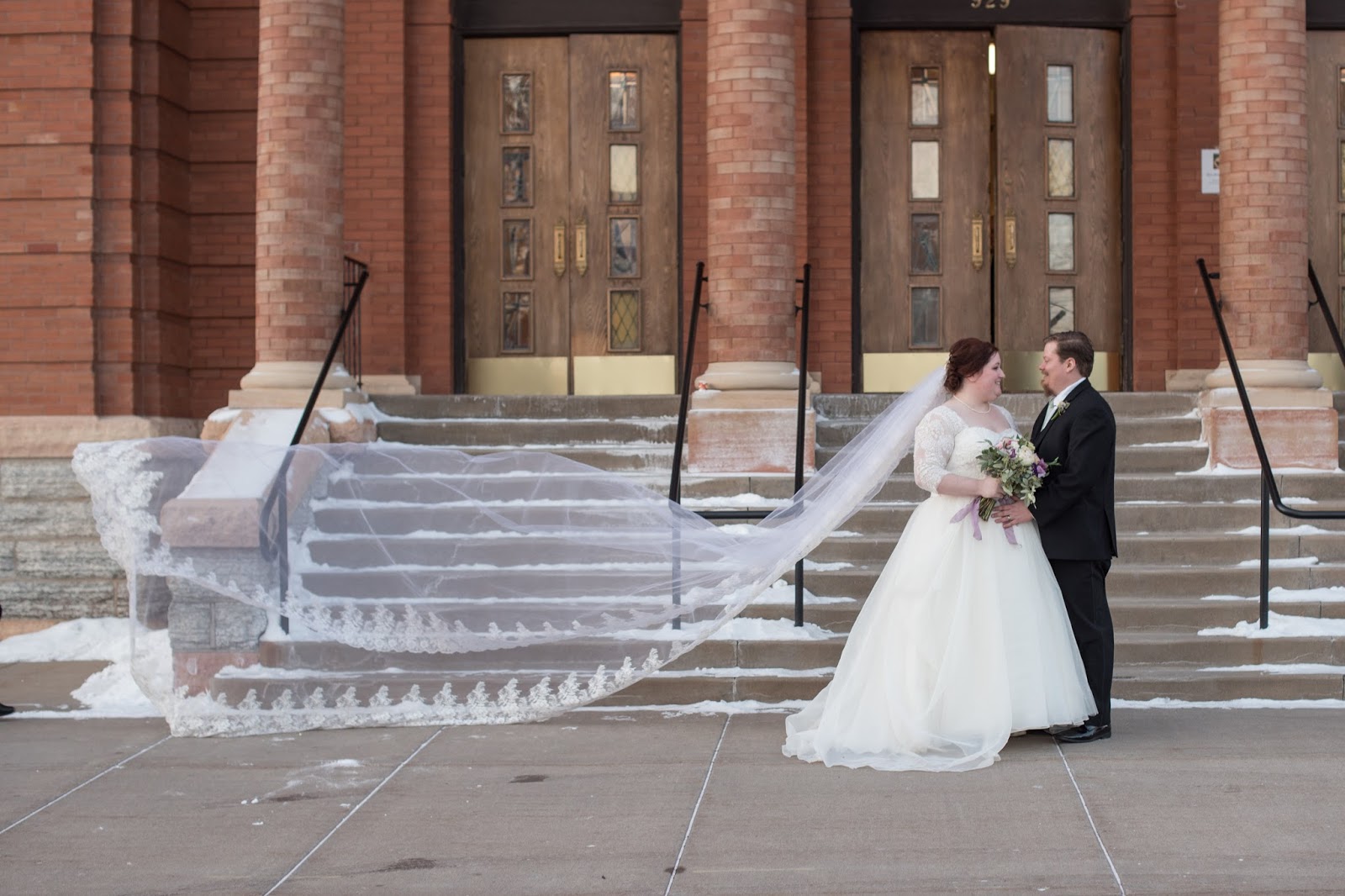
It was not a historical wedding, for a variety of reasons, but my veil was made for me as a wonderful, wonderful gift by Elizabeth Stewart Clark (she of Sewing Academy fame, and obviously an amazing friend). I asked for 14 feet, a bit longer than a cathedral veil. She decided it should be twenty feet. I wasn't easy to manage moving it (it took a team to haul it around), but it was a dream come true and very much worth it.

It's not related to reenacting, but here's some pictures:


Now that the wedding craziness is done, I'm looking forward to reviving this blog. Stay tuned!

Thursday, May 26, 2016

AAR: A Country Ramble

Three years ago, I discovered this adorable bed and breakfast in the Kettle Moraine in Wisconsin - a reproduction of an 1840s stagecoach inn, faithfully decorated with antique beds and furnishings (with all the modern conveniences of plumbing, electricity and HVAC). It seemed purpose-built for a semi-immersion event. My mind churned it over for a year and some change before I figured out exactly what I wanted to do. And last week, my dream event came true - portraying pleasure travelers at an inn, going "rambling" during the day and enjoying the lovely inn at night, with a small group of friends who were specially invited.

The Gentleman Friend (aka Mr. Watkins) and I set off on Thursday and arrived at the inn on Thursday evening. The event was to start on Friday afternoon, but we wanted to make sure we had everything set up logistically. We took the opportunity on Friday to go scout out trails - we'd never been in the Kettle Moraine State Forest, so we needed to make sure the trail was accessible to everyone in the group, was interesting enough to keep everyone entertained, and was manageable in cage crinolines and leather-soled shoes. We were lucky - we stopped at the forest headquarters to grab maps and pay for our permit, and we got a hot tip from the ranger about a likely option just down the road. It turned out to have everything we wanted. This was an auspicious beginning! We celebrated with a Tex Mex lunch.

Everyone arrived in the afternoon - a group of several friends from across Minnesota, Wisconsin and Illinois. We had a brief meeting, went out for dinner as a group, then settled into our comfortable rooms for the night.

We woke up in 1860. Walking downstairs to the first floor in my wrapper, I discovered Mr. W. already awake and reading in the tap room. He had seen some of the other guests coming down for coffee and tea, but no one was around yet. The morning paper had arrived with plenty of interesting news and advertisements. Slowly, the rest of the guests filtered down for breakfast - cinnamon toast with syrup and jam, berries and cream, and local sausages. The newspapers had arrived, and the innkeeper was full of her own local tidbits - the train was delayed, she informed us. Thankfully, none of us had planned to leave that day. Conversation at breakfast revolved around getting to know one other - who we were, where we had come from, and what our travel plans were. I told our fellow guests, Mr. and Mrs. Warren, that I was visiting with my friend, Mrs. Middleton, and my sister, Mrs. Chapin, on our way to the resorts further north. Mr. W. was there as our escort. The Warrens were in between visits to their two sons, one of whom resides in Madison and the other in Milwaukee.

After breakfast, we retired to our rooms to change for the day. Once we were dressed (several of us in sporting outfits, with walking staffs), we set out to see the countryside. There was a nearby rock outcrop, known to the locals as Brady's Rocks, which we wished to see. We began first by walking across some tall-grass prairies - the sun was warm, but there was a nice breeze to mitigate that. We climbed a hill to see the view over the countryside, with its ridges and "kettles". Some of us stayed at the overlook, and the rest valiantly pressed on into the woods, to see Brady's Rocks, which were quite picturesque tucked back in the woods.

Back at the inn, we had a leisurely lunch on the porch. Some of us retired to rest (as they were traveling for their health, after all) and some of us sat on the porch. Mrs. Pestel read several stories to us, and Mrs. Lucking filled us in on the latest story in Harper's, The Woman in White. The rest of us sewed, or simply lounged about and enjoyed the peaceful afternoon.

In the evening we all sat down for a rustic but hearty dinner, with a delicious custard and raspberry preserves for dessert. Major Lucking offered a few toasts during the dinner. Afterwards we retired to the parlor for a relaxed evening. Some of the ladies played cards, while others read or knitted. Mr. Ackeret, Mr. Watkins and Major Lucking played an old board game, Every Man To His Station, which left them, according to Mr. Ackeret, needing to reconsider their life choices. The moral of the game was, apparently, a bit hazy, since every action required a forfeit.

The next morning dawned bright and clear. The newspapers waiting in the parlor provided interesting conversation about the Democratic Convention and the unprecedented split in the party. As we finished our breakfast (a delicious egg pie), we discussed our departure and where we would be headed next - some of us were headed home, some on to other adventures.

All in all, it was a fabulous event, and everything I wanted. We were able to achieve some experiences that few people get to have, like 1860s hiking, and the opportunity to experience pleasure travel. This event encompassed so much of what I want to achieve in mid-19th century events - finding opportunities in our own backyard to focus on being civilians and discovering through experimentation just what it was like to live in the mid-19th century, separate from the military. For these types of events, all you need is friends who want the same thing and are willing to have fun and work toward an immersive environment.

Have some pictures! They're slightly less terrible than usual!


As a note: the inn where we stayed is Eagle Centre House in Eagle, Wisconsin, between Madison and Milwaukee. It's a really gorgeous place, with a lovely innkeeper who deserves every single shout out I can give.

It's me! With a new dress that miraculously got done and FIT!
The elusive Gentleman Friend, in his 1860s clothes. It was his first event, and we almost killed him, but he survived, despite pictorial evidence. Better yet - he said he'd do it again!

Tuesday, March 22, 2016

There and Back Again (or, maybe I'm crazy)

It's that time of year when I re-emerge and give all sorts of excuses about where I've been! Here's a list of all the things that happened in the last year:


May: I went to the reenactment of President Lincoln's funeral in Springfield. It was a long drive to get there, and it was very warm, but I'm so glad I went. It was a meaningful experience that moved me to tears as I came to understand the grief experienced by the nation in 1865. I also became CSPAN-famous.


June/July: I got a new job! I switched from being an instructional designer for a retail corporation to a senior instructional designer for a healthcare organization. It's a step up and I really enjoy the company I work for and the team I work with. In the midst of all that, I was prepping and planning for...

August: Being civilian coordinator for a massive reenactment at Fort Snelling as we reenacted the return of the Second Minnesota to St. Paul in 1865. I spent the majority of my time in 2015 planning this thing, and it was absolutely worth it. The experience was incredible and one I won't forget any time soon.


It was also really hot out. My curlicues and glistening face prove it. It will become a theme during the rest of the year.

September: I moved! Just down the hall in the same apartment building, but moving is moving. I now have my own sewing space, and a greater appreciation for all the fabric I own. It takes up a lot of space and is heavy to lug, even if it's just down the hallway.

A week later...

October: I went to a small, private reenactment in Illinois. I might be crazy, but this event is important to me and I made it happen. It was also too hot, but it was a peaceful time hanging out with friends and sleeping in my home-away-from-home dogtrot.


November, December and January were the busy times at the new job, and the holidays, and getting ready for other stuff like...

February: My reenacting group's annual formal ball! Pictured elsewhere on this site in other years, it was a lovely time as usual. It was even more special because I brought The Gentleman Friend to the Friday night sociable. It was his first time dressing up, and he looked pretty snazzy if I do say so myself.


And there was an extra day in February, so we took advantage of that by getting engaged! It is very exciting and we're both very pleased with ourselves. We bought each other rings, and I am pretty much in love with mine - it is an antique from England, almandine garnet with seed pearls.


We will need to find a new pseudonym for him, because soon he won't just be The Gentleman Friend!

But, there was no time to rest, because the next day was...

March, and it was time for me to present at the Civilian Symposium in Harrisburg! It was truly an honor to be on this year's faculty, and to present with Jessica Craig on planning civilian-focused, history-heavy events. And of course, I got to make a dress - the tradition at the Symposium is that all the faculty get a length of the same fabric (dress length for women, vest length for men, usually two different fabrics) and told to make a garment from it. I decided to try something different and do 1840s. It was such a fun and unique experience, and I hope to be able to do it again soon!


And that, gentle readers, brings us up to date. I am currently working in Pittsburgh for the week (and sincerely, Pittsburgh is both a charming and a weird place, with its hills and its friendly people and its salads with french fries on top) but I am ready to get back home and start on some new adventures! I am hosting an immersion event in May, I have some commissions keeping me busy, and then there's this wedding coming up...but I hope to be able to tell you all about it here!

Monday, April 27, 2015

Ask Me Anything: First Round

I'm very busy getting ready to attend the Lincoln Funeral in Springfield this weekend - leaving town on Thursday means I'm working on a new bonnet right now! I'll have plenty of pictures to share when I get back, but to take a break from the stitching (because I've been going gangbusters for the last few weeks, guys), I'm answering a few questions from the Ask Me Anything I posted last week! You guys ask good questions, so I'm just picking them out as I am able to answer.

"Do you plan to branch out into bustle era any time?" - Elizabeth M.

You know, probably not. I have nothing against the bustle era at all. It's just not my jam. I think most people have a certain period that they're in love with, and mine stretches from about 1770 to 1864 (recent events having taught me that yup, the love stops right at 1864). That's sort of where my interests in history fall as well.

But then I see something like this, and all bets are off.


"Where do you do your research on the small elements that make your impression so awesome?" - Cheyney M.

Cheyney specifically mentioned the trim on the sleeves of this dress. Don't let small children see this picture, my chronic case of BRF might scar them for life.

I am really not crabby in reality! I swear!

It's less about research and more about developing The Eye. When I say "The Eye", I mean the instinctive knowledge of what just looks right, and what looks off. I think there's something innate to this; when you have a visual aptitude, you can just naturally look at something and know that it's "on" or "off". When I was a teenager, I had a covered hoop from a sutler, and I knew that something about it didn't give me the silhouette that I wanted, and when I figured out what it was (too big, too long, not enough of a dome shape), I redid the waist and adjusted the boning to make it smaller. However, I also think it can be learned by anyone willing to take the time to start training their eye and thinking visually.

 Whenever I get to researching something, I start by looking at as many examples as possible to develop my eye - print fabric, baskets, transferware china, you name it. I'll utilize a lot of different resources, but my favorite is just to dive into the digitized collections of museums - Kent State, the MFA, the V&A, the Met, Old Sturbridge Village, and so on. I'll also look at illustrations, images and fashion plates. I could write a whole treatise on what I look at, but I'll consider color, shape, size, how it compares to other examples, and what the majority of examples I find show. In the picture above, I got the inspiration for the trim from a dress at the Smithsonian (which I now can't find pictures of, naturally) and my main consideration was in getting the scale right. How big is the trim? How is it positioned? What is the scale of it going to look like on the sleeve I've created. (Insider tip: getting those chevrons angled just right on shaped coat sleeves took a long, long time, and many time trying the sleeves on before I got it exactly the way I wanted it).

If you're trying to recreate a specific look, Elizabeth Stewart Clark suggests a great idea: take a picture of yourself/the item/the dress you have created, and then take the image of the original you're trying to replicate, and put them side by side. And then ask yourself, "What do I need to do to make that look identical? Why doesn't this look like that? What's missing or different?"

So, to conclude what was probably a longer answer than necessary: look at as many things as you can possibly get your hands on, and think critically about what it takes in all aspects to make it look right.

Wednesday, April 15, 2015

Ask Me Anything!

I have been conspicuously absent after the Symposium, and I apologize for that. I even promised pictures and AARs. Bad Betsy - but there are good reasons for it, which I am currently working on.

In the meantime, I'd like to do an Ask Me Anything! I've already posted on my Facebook asking for questions, so I'm putting it out here for those who aren't friends with me on Facebook.

Ask me anything - about reenacting, about myself, about anything! Don't be shy! And if you are shy, use the form at the right to send me an email. I can't promise to answer all of them, but I will sure try my hardest!

Friday, February 27, 2015

New Adventures

Hi everyone! I'm just checking in while I sit here at the airport, waiting for my flight to board. I'm off on a mid-winter vacation to Washington, DC to visit my brother and his girlfriend. I'll be visiting lots of museums and hope to take a Civil War walking tour, so stay tuned for pictures and such.

After spending four days in The District (see, I can blend in!) I will be heading up to Harrisburg for the Civilian Symposium! You may know it by its former name, The Ladies and Gentleman of the Mid-19th Century Conference. This is a dream come true for me, and I'm super grateful to my reenacting group for helping to make it happen by providing me with some scholarship funds. I will be enjoying the lectures, drooling in the vendor room, and yes, I have a dress for the fancy-dress party. If you're going, I hope I'll see you there - make sure you say hi! And if you won't be there, I'll be sure to share lots of pictures.
Sneak fancy-dress preview...

I've been very busy getting ready for this! This winter has been a lesson in diligence as I replaced all the things I lost. I owe so much to some really generous friends who came through for me and provided me with some things, including a cage crinoline kit and some undergarments! Still and all, I had to wait for my new corset (courtesy of Originals By Kay) to get here, and had to build the new cage crinoline.
I had a little bit of help...

With a little luck and a prayer, I got it done in time for my group's ball last weekend! It felt so victorious to get dressed up and put on the Empress Gown again. I even got a decent full-length shot of it - I know, it's only been two years...

Now that that's done, I still have a couple other things to get done, like another petticoat or two and some more chemises and drawers, and plenty more to procure, but I'm just glad I can get dressed up for the Symposium.

My flight will be boarding in just a few minutes - and yes, this time I am carrying on all my Civil War gear...here we go!


Monday, December 1, 2014

What I Learned When I Lost Everything

On October 13th, after the aforementioned lovely weekend of living in the 1860s, I arrived at Union Station with Civil War Bestie Ashley to catch a train that would take me home to St. Paul. I checked my bag in at the Amtrak counter - we both cheered when the scale read 49.6 pounds - .4 pounds under the baggage limit, which was a feat, considering it contained almost all of my reenacting gear from the past weekend's immersion reenactment. The woman checking me in smiled that benevolent, "Oh you silly kids" smile, and took my suitcase away.

That's the last I have seen of it. My worst nightmare came true - my reenacting clothes are gone.

The details of my dealings with Amtrak are long, and sordid, and are best told on another day. Suffice it to say that at this point, six weeks later, they cannot explain what happened to it or give me any idea of when they will find it. For the last six weeks, I have felt what it is like to lose the core of your reenacting clothing. Thankfully, I still have most of my dresses. The dresses that were in the suitcase were fairly unique (one of them was my mourning dress) and losing them is a big hit. The worst part is that I do not have a single undergarment to my name. No corset, no cage crinoline, no petticoats, not even a chemise.

A claim has been submitted for the (gut-wrenching) worth of everything in the suitcase. The story isn't done, and we will have to see where things go from here. But I'm not interested in talking about the details of what exactly went down - I want to tell you the life lessons that I have learned from this ordeal.

It's Just As Awful As It Sounds. I cannot put into words the awful feelings I have felt the last month. You know the eight stages of grief? I went through all of them. Disbelief, despair, anger, bargaining...I was down with all of them. I still am, to a certain extent. To put it into words for people, I told them to imagine an artist who watched all their paintings go up in flames. It's not so much the physical items themselves as what they represented - time, energy, the amount of research, all the love and attention to detail that I poured into each of those things.

There are a few things that are more gut-wrenching than others. Possibly one of the worst is my cloth doll, Dolly. I'm just a big little girl, and the idea of Dolly being lost forever still brings me to tears. Don't judge.

So I wallowed in my grief for a month. I wept copious tears on the shoulders of my friends, my family, and my Gentleman Friend. There was an incident at work where I got stuck in my office because I was too ashamed of my mascara streaks to get to the bathroom and wash my face. But...

You Can Rebuild. I didn't start feeling better until I started taking action. I created a spreadsheet that listed every last thing in the suitcase. I hunted down documentation for those prices. The price I came up with is vomit-inducting (let's just say it's four figures, and it's more than I make in a month at my decent corporate job). Once I made that list, though, I saw the length and breadth of what I lost. I realized just how replaceable everything was, and though it was scary to look at that spreadsheet with all its rows and prices and amounts, it made everything seem more realistic.

Advice Is Not Always Helpful. I have struggled with this point. People are genuinely nice and caring, and that caring sometimes comes out as helpful advice. The problem comes when that advice is offered over and over and over again. Ask me how many times I've been told how to file a claim with Amtrak. Ask me how many times I've been told to check eBay, Etsy, and the like. The answer is "A whole heck of a lot."

Of course I'm not angry with people. Those who offer advice generally (not always, but probably 99% of the time) offer it in a spirit of helpfulness, and often because they too have lost luggage and know what the process is like. What I have taken away from this, for myself, is that when I plan to offer another person advice or helpful hints, I should pause and ask myself if it's necessary. Much more helpful to offer a sympathetic ear and a pat on the back. This video touches on that:


People Are Wonderful. When something like this happens, it's quite easy to feel very much alone. I was absolutely that fox in that deep, dark hole. I felt like I was fighting this battle alone, and the burden of it was very heavy. Then my friend, Melissa of The Deviant Dressmaker, suggested I put out on Facebook what I was going through, and ask for some help to get some things sewn. I anticipated a few people offering to sew me some undergarments to at least get me to a few events in the coming months.

What I got was overwhelming. People crawled out of the woodwork to offer help. I posted a list of everything that had been in that suitcase that needed to be made (nothing store-bought, and nothing manufactured), to keep it straight. Less than 24 hours later, almost everything had been spoken for, from my chemises and drawers to my wrapper to my cage crinoline (yes, my cage crinoline is being replaced by the generous and amazing Carolann Schmitt). There are people who can't sew, but offered materials to those who could. There are people who can't sew, and asked me what they could buy. There are people who I have never met, and people who didn't even know me before this, but they heard about what happened and want to help. There are still people offering help, and I'm actually turning them away, because there's nothing left to be made. It's all being relaced.

After all that stress and anxiety, feeling hopeless and helpless and full of despair, I finally broke through. I honestly cannot believe how kind and generous people are. There aren't words to express the gratitude I feel, or the warm-fuzzies that are filling my heart to overflowing. I take it as a very large pat on the back, that there are people out there who appreciate me and who care about me and who want to see me smile, in spite of everything. A huge thank you goes out to all of them for their kindness and generosity. If there's anything I want to take away from this, it's that people are good, and that I have amazing and wonderful friends.

Monday, October 27, 2014

You Win Some, You Lose Some

It's been a busy fall! I'm sad to say that other things besides reenacting have kept me busy. I took a couple of trips to visit friends and have been staying very occupied at work - when one works in retail, the autumn becomes eaten up with preparations for helping lots of people have very merry holidays.

Earlier in October, I was away at an immersion event. My Civil War Bestie and I traveled to southern Illinois, to a little collection of original log cabins. It was a very small event, but we got to spend time with some friends I do not get to see nearly often enough, and make some new friends that I can't wait to see again.


The front room of this dog trot was our home away from home for the weekend - and I daresay it's now a permanent home away from home. I'll be honest - I haven't done a lot of real "roughing it" kind of events, mostly because I'm not a real roughing-it kind of girl. For this event, I got to be a maid in the tavern and serve meals and wash dishes. I gathered kindling and hauled firewood, kept the fire going in our cabin, and hauled buckets of water with a shoulder yoke (that's one I can cross off my reenacting bucket list!).


I absolutely adored this event, and I can't wait to go back. I was so impressed that all the attendees really, truly paid attention to the "no cell phones, no cameras, nothing modern" rule. So often everyone agrees to these rules, and then around Saturday afternoon things go wonky and things start to slip out. You see a camera or two pulled out, or catch someone smoking a modern cigarette. I didn't see a single cell phone all weekend. It was marvelous, and so vanishingly rare.

I also learned things. I've been in this hobby for well over a decade now, and certain things start to feel like a broken record - the same event, doing the same programs, every single year. It takes an event like this to shake me up and keep me on my toes, and to learn things I hadn't learned before. I learned just how important it is to have a fire in the morning (not just for the heat, but to pull out the damp). I learned what it's like to sleep on a rope bed, and how important spooning is (VERY). I learned that when you don't have much else to occupy you, sitting on the porch and sewing while watching the neighbors going about their business (and gossiping about them) is really just as good as TV. I learned what the real pace of life was in the rural Midwest.

Like I said, it was a marvelous weekend. And then tragedy struck. You see, I had used a major transportation service to get to this event, so that I didn't have to drive by myself. I had checked my bag in with this company, and it got to Chicago just fine. But on the way back, it didn't make it back to St. Paul. And it still hasn't made its way home yet. It contained a good portion of my reenacting gear - three dresses, all my undergarments, my corset and cage crinoline, all the way down to hair pins and pomade. I have a spreadsheet detailing the entire replacement cost of the suitcase and its contents, and it's stomach-churning.

To say I am a bit distracted is an understatement. I can keep it together for about five days at a stretch, and then I have a meltdown. It's been two weeks, and I still have hope they will find it, but it is very hard to sit and wait, not knowing when and where it will turn up, and to fill out the claims forms like it's never going to be seen again. I have been doing all the right things and handling everything the best way possible (and the next person who says "Did you do XYZ?" is going to be strangled, so please, no helpful advice needed).

If you are a praying person, prayers would be appreciated (I've got St. Jude, St. Christopher and St. Anthony on this). If you're not, crossed fingers and good wishes are appreciated too. I'm looking forward to the day when I can report back that everything is back, safe and sound.

Monday, September 1, 2014

The Summer Side of Life

Well it's been a while, hasn't it? Life has been simultaneously busy and un-busy for me. Summertime is always busy with everything - travel, hiking, canoeing, drinking on patios, sitting on balconies, and enjoying what has turned out to be my ideal kind of summer (warm days, cool nights, low humidity, just enough rain).

There just also hasn't been a ton going on, reenacting-wise. I'm prepping for some fun stuff in the next couple months, including an out-of-state immersion overnight, so that has taken up some attention. I've also been blogging more of my food adventures over at the Historical Food Fortnightly, so be sure to follow that blog to keep abreast of what I've been up to in the kitchen! Teaser: sometimes I win, sometimes I lose.

I've also been working on some other writing projects and presentation proposals for some really awesome things, so my writing energy/time has been diverted elsewhere. All the same, I've been working on some posts, so stay tuned for more of that!

And - new background, which I love! Thanks to Shabby Blogs, as usual.

In the meantime, fall is when I usually take on some commissions. I have some spare sewing time between October and April and am willing to take on a few projects for customers. I don't do much by way of menswear, but all my skills (embroidery, sewing, millinery, etc) are for hire. If you're interested in hiring me to make something, send me a message!

Wednesday, June 18, 2014

Reproducing Puff Pastry

I’ve been asked from several people about the process for making the puff pastry for the plum puffs on the Historical Food Fortnightly. If I’m calculating correctly, based on the reactions I’ve gotten, I may be the only person in a 100 mile radius crazy enough to make her own puff pastry. The process itself is not difficult, or even fussy, it’s just really, really time-consuming. It takes a few hours to do it completely. That said, the results were so incredible that it’s definitely something I’ll be trying again.

As I mentioned in my original post, I looked at different recipes from different eras and discovered that puff pastry has not changed much in the last 170 years. Good news! I felt comfortable taking some tips and tricks from modern recipes and utilizing them with the historic recipes. Now that I’ve got a handle down on the process, and know that I can in fact make puff pastry, I will probably try a more purist version of a historical recipe, just to test the difference.

I made a simple paste dough of flour and water. You want it to be wet enough to hold, but not so wet that it gets sticky. I set it aside to let the gluten relax.

Next, I chilled the butter. I found a variety of techniques for getting the butter into the dough, but the best technique (modern) I found was to take room-temperature butter, put it between two pieces of cling wrap, and press it down into a flat disc. I did that, and then chilled it. A bit of a cheat, but not so dissimilar from period techniques of putting butter shavings or pats of butter on the dough and folding it up.

Once the butter was chilled, and the dough relaxed, I rolled the dough out. I put the disc of butter on top of the dough, and folded the dough up over the butter so that the butter was completely encased in dough. Mrs. Hale describes it as folding it up like an envelope.

Then, I rolled the dough out to a half an inch. I folded the dough in thirds, turned it 90”, and rolled it out again. This is referred to as a “turn”. I did one more turn, then chilled the dough - the butter was starting to get soft, and the trick for a good puff pastry is to keep the butter from breaking through the dough. So, after every two turns, I chilled it for about half an hour, wrapped in plastic wrap to keep it from drying out. What you’re basically doing is building in each layer with the folds. The more turns you do, the more layers the dough will achieve. Six turns is standard, but more can be had if, I don’t know, you’re under house arrest or an insomniac.

One last chill, and you’re ready to cut out. Cutting out in circles makes a ton of waste. It was sad. I baked them at 400 degrees - you need a hot oven to get enough puff. I was concerned about going any hotter (my apartment oven is a bit unreliable) but I think next time I’d bump it up to 425 to get even more rise. I baked them for 15 minutes on baking sheets lined with parchment. Once they’re baked, you need to leave them untouched as they lighten/harden. Think of it like a meringue or something - it needs to cool.

So that’s it! It’s pretty simple, as long as you stick to the rules and have enough time and space to make it. I think the key is plenty of chilling between turns, to keep the butter manageable.

Thursday, June 12, 2014

Historical Food Fortnightly Challenge #1

It's here! The Historical Food Fortnightly (which I've taken to calling the HFF for expediency's sake) has kicked off. Our first challenge was Literature - foods from literature, or inspired by literature. I thought it was a good way to start off - not too challenging, but still requires research, and tickles one's creative fancy.

I chose plum puffs from Anne of Avonlea. I blogged about the experience over at  the HFF blog. Melissa also posted her results for baked apples from Emma, which look super delicious!

I've been absolutely blown away by the enthusiasm for this project. It's been so amazing to see how many people are participating, and how enthusiastic they are. The Facebook group has been full of inspiration and encouragement. We're also supporting each others' bad food decisions - there was a consensus made this evening that anything with the word "bread" included in the name can be eaten for breakfast, including breadcake (totally legit, right?). It's just so cool to see a little brainstorm that I had turn into a worldwide phenomenon!

This weekend I'll be posting some highlights from other participants, and teasing the next challenges over on the HFF blog - keep an eye out for it!